Your Head of Sales search
Saw you're hiring a Head of Sales for the Pune team.
We find the right companies, write to them, follow up, answer the replies, and book the meetings into your calendar.
 5:23
5:23Watch the film
0:00Not enough leads coming in. You refresh the inbox, and there's nothing new.
0:06So you try emailing new companies. It usually goes wrong in four places.
0:11One. Nobody has the time for it.
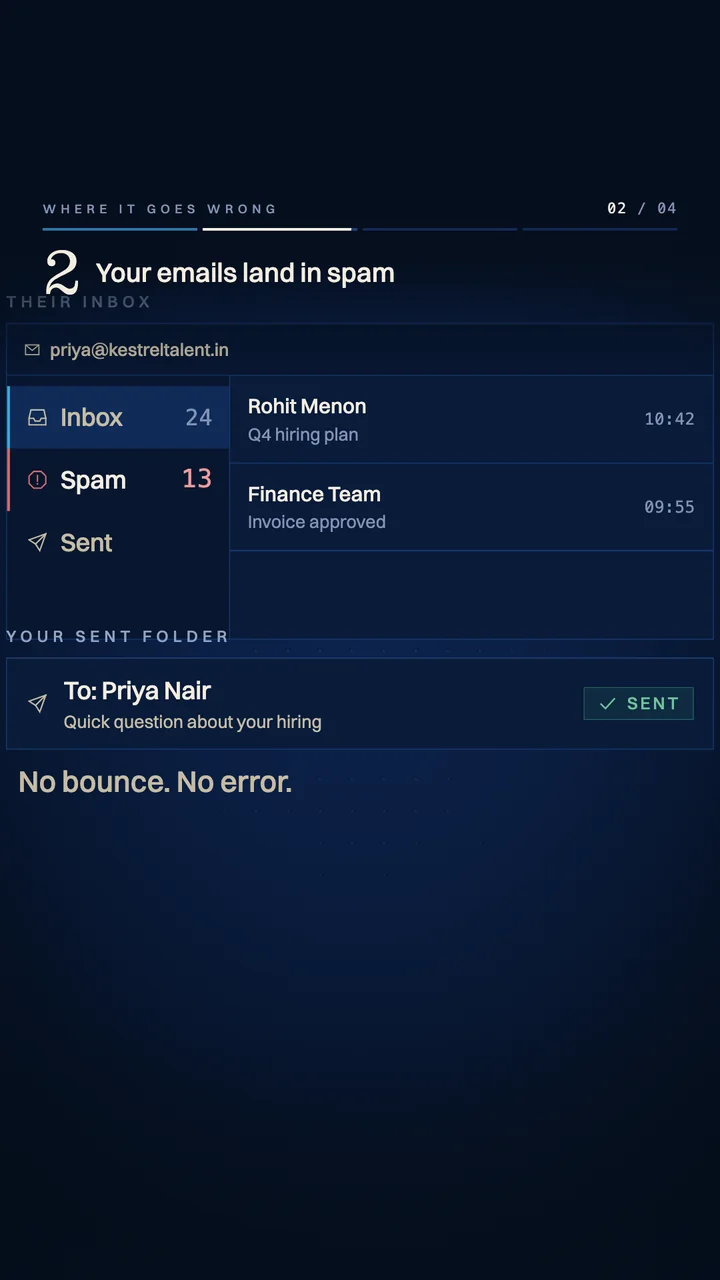
0:15Two. Your emails land in spam, and nobody tells you.
0:21Three. The list is old, so emails bounce back or reach the wrong person.
0:27Four. Replies wait for days, and people who said not now are forgotten.
0:35So we take the whole job off your hands. It's called the Managed Outbound Channel.
0:42We find the right companies, write to them, follow up, answer the replies, and book the meetings into your calendar.
0:52Step one. We agree who you want as customers. Each campaign gets one goal, like reaching new companies, reviving old leads, or finding more like your best customers.
1:05Step two. We set up separate inboxes on web addresses like yours, so your main email stays safe.
1:15Each is set up so Gmail knows it's you, then warmed up for three weeks, on an account used only for you.
1:24How much we send depends on what you need, from 18,000 emails a month up to 80,000 or more.
1:33Step three. We search wide. Then an AI agent reads each company's website, to check it's the kind you want, before we look anyone up.
1:43Step four. We watch for a reason to write, like a new hire, funding or a tender, so each first email opens with a line meant only for them.
1:55Step five. Every address is checked, down to whether the person still works there.
2:01If more than two in a hundred would bounce, that list isn't sent.
2:07Step six. Three short emails in one week, the third with a new angle. Then we stop, or move to LinkedIn for the ones worth it.
2:16We test the wording one change at a time: subject lines, opening lines, and what we ask them to do.
2:25Then someone replies.
2:28Step seven. Within a minute, an AI agent reads the reply and sorts it: interested, a question, not now, or an out-of-office.
2:39It's answered your way: book them straight in, ask your questions first, or hand them to your team.
2:47At first, a person approves every reply. Quotes and contracts always go to your team.
2:54Step eight. The conversation carries on by email, LinkedIn, a call, or WhatsApp once they've agreed.
3:02Our research travels with them, so a brief is ready before the meeting: who they are, why we wrote, and what to ask.
3:11And your CRM, where you keep track of customers, fills itself in.
3:17Step nine. Meetings get booked, confirmed and reminded, and no-shows get followed up.
3:25If someone says not now, we note why and set a date, and the follow-up goes out by itself.
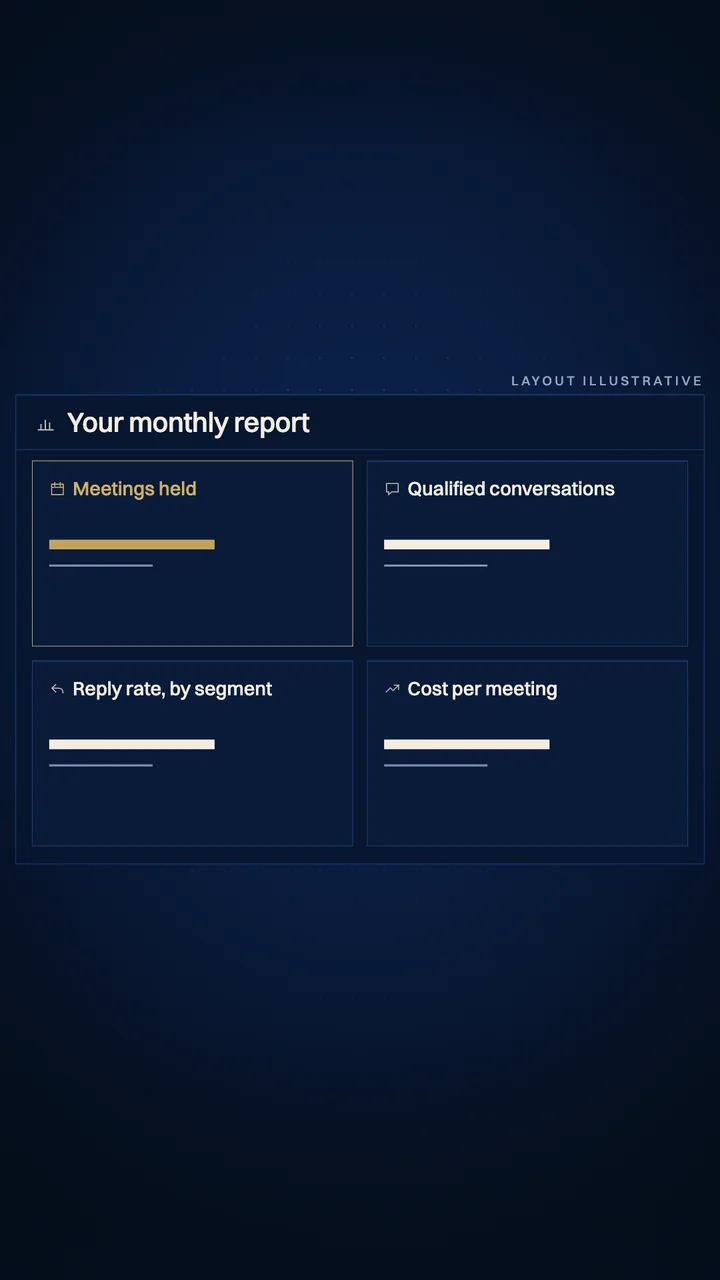
3:33Every month, one report: meetings held, qualified conversations, how many replied, and what each meeting cost.
3:44Qualified means they fit, they're interested, and they've confirmed a meeting.
3:51We don't track opens. That needs a hidden tracker in every email, and spam filters count it against you.
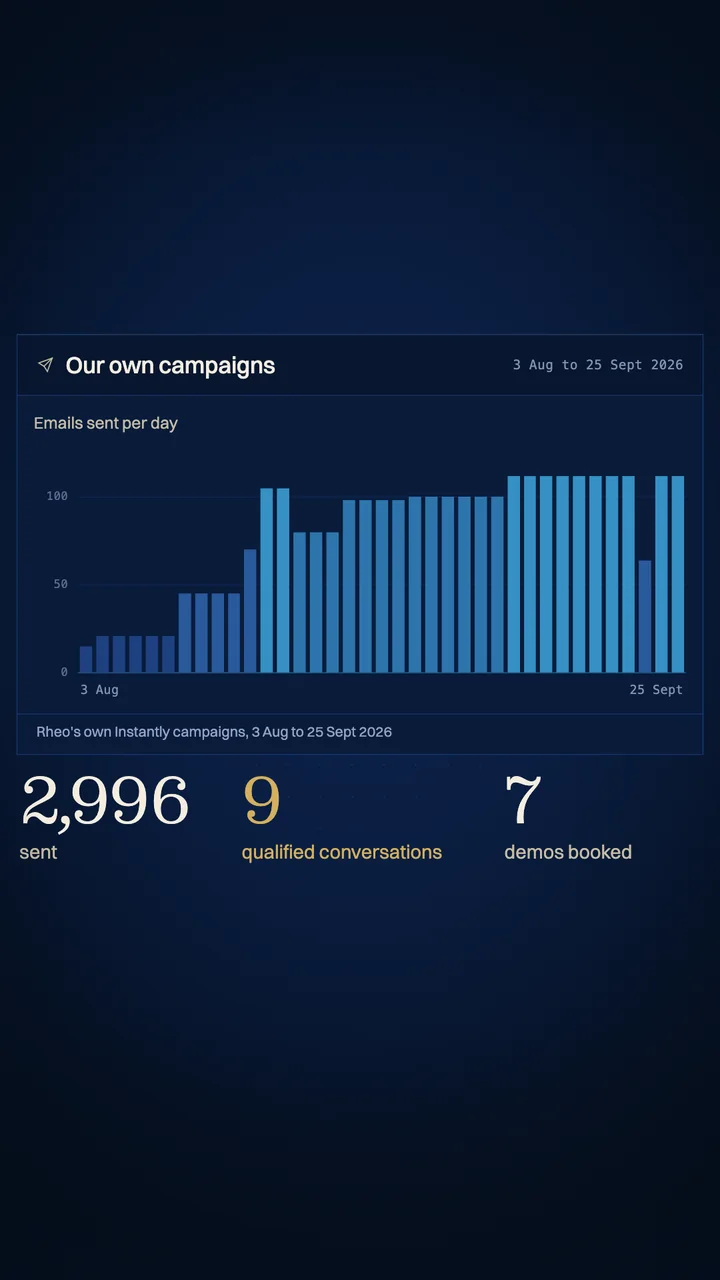
4:00We do our own outreach too. Since August, nearly 3,000 emails, 9 qualified conversations, and 7 demos booked.
4:11One company ignored our first two emails. The third got a reply in 55 minutes, then a call, then a demo booked.
4:21And the channel is sending by week four. A new sales hire usually takes two to three months to get up to speed.
4:31We'll never promise you a number of leads, replies or meetings. Judge us on whether the work is done properly, and whether anybody got lost.
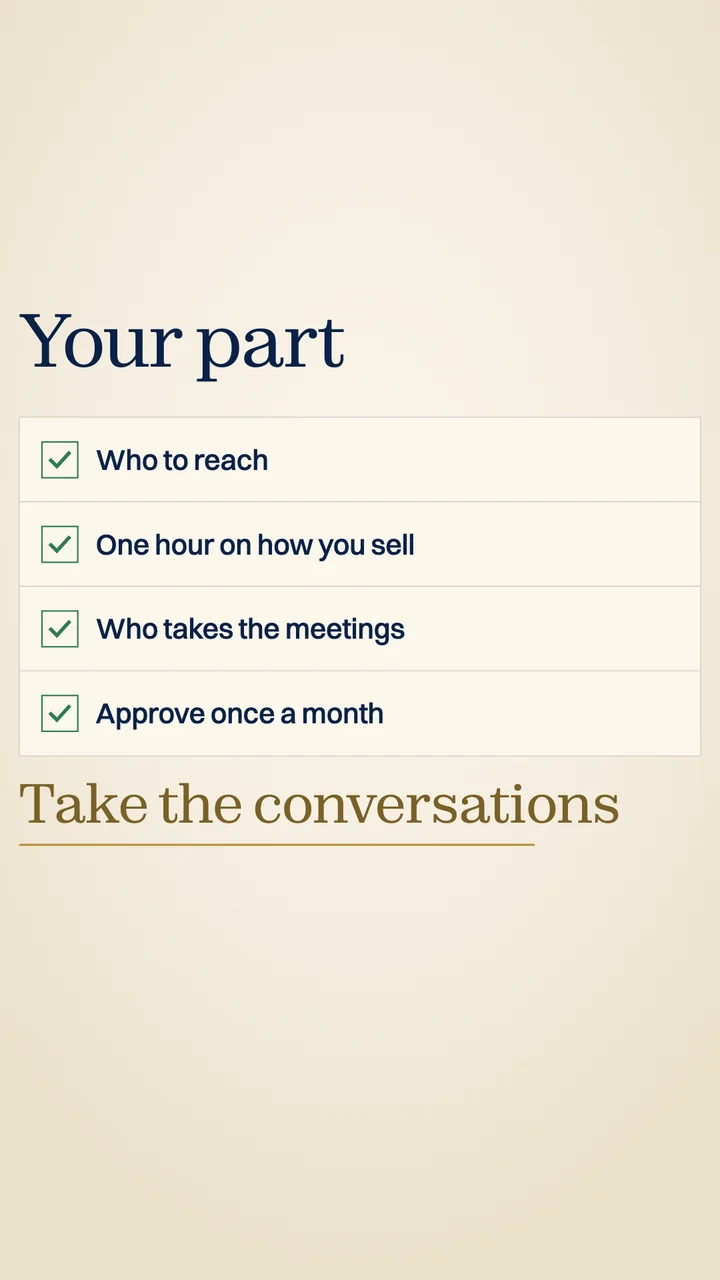
4:42Your part is small. Tell us who to reach, give us one hour on how you sell, and name who takes the meetings. Then approve once a month, and take the conversations.
4:57It starts with a thirty-minute call. If it's a fit, you get a written plan within five working days, with the first ten companies we'd contact. Free, and yours to keep.
5:11The Managed Outbound Channel, by Rheo AI. Book your call on this page.
Where it goes wrong
Client work comes first, so emailing new companies moves to next week, and then the week after.
Your Sent folder shows a tick while their inbox files your email under Spam. There's no bounce and no error, so nobody tells you.
Emails bounce back, or reach someone who has left the company or works in another department.
A reply on Friday evening gets read on Monday, and the people who said not now are forgotten.
Your Sent folder · Sent
Their inbox · Spam
How it works
Steps one to six reach the right people. Steps seven to nine are what happens when they reply. Each step has its own chapter in the film.
01 / 09
We agree who you want as customers, by industry, city, company size and who makes the decision. Each campaign then gets one goal, like reaching new companies, reviving old leads, or finding more like your best customers.
A first meeting with a company that has never heard of you.
Firms that match your ideal customer and have no history with you.
You place senior hires for manufacturers across Pune, so this may be worth two minutes of your time.
02 / 09
We set up separate inboxes on web addresses like yours, so your main email stays safe. Each one is set up so Gmail knows it's you and warmed up for three weeks, starting with a few emails a day, on an account used only for you. Then we send from 18,000 up to 80,000+ emails a month, depending on what you need.
Worked out in your browser. Nothing is sent.
18,000 emails a month
30 emails a day per inbox. 4 inboxes per web address.
03 / 09
We search wide, across maps, business directories, web search and professional networks. Then an AI agent reads each company's website to check it's the kind you want. We only look people up at the companies that pass.
An AI agent reads each website. Checked before anyone is looked up.
Altair Executive Search
Leadership hiring for manufacturing firms
Hires leaders for manufacturers, which is who you sell to.
Next: find who decides04 / 09
We watch for a reason to write, like a new hire, funding, a tender or a new office. So each first email opens with a line meant only for that company. Where there's no fresh reason, the line is about something specific in their business.
Why nowHiring a Head of Sales · 2 days ago
Saw you're hiring a Head of Sales for the Pune team.
The rest of the email
05 / 09
We check that every address is real, that it belongs to the company, and that the person still works there. If more than two in a hundred on a list would bounce, that list isn't sent.
Estimated bounce rate for this list of 8301.2%
LoadedFewer than 2 in 100 would bounce, so the list goes out.
06 / 09
Three short emails go out in one week, on day 0, day 3 and day 7, and the third comes with a new angle. Then we stop, or move to LinkedIn for the people worth it. We test the wording one change at a time.
Your Head of Sales search
Saw you're hiring a Head of Sales for the Pune team.
Re: Your Head of Sales search
The one question most founders ask us, answered in two lines.
A different idea for the search
Most new sales heads spend month one finding leads. We could take that part.
Stop
No fourth email
For the ones worth it
A short connection note
SubjectYour Head of Sales search
Saw you're hiring a Head of Sales for the Pune team.
The one changeWorth a 15-minute call next week?
Under 200 sends, a result is only a hint.
Still a hint
07 / 09
Within a minute of a reply, an AI agent reads it and sorts it: interested, a question, not now, or an out-of-office. It's answered your way, by booking them straight in, asking your questions first, or handing them to your team. At first, a person approves every reply, and quotes and contracts always go to your team.
Ritika RaoAltair Executive Search
This looks relevant. Can you share more?
Thanks, Ritika. The quickest way is a 20-minute call. Thursday at 11:00 or Friday at 15:00 both work. Shall we hold one?
Quotes and contracts always go to your team.
08 / 09
The conversation carries on by email, LinkedIn, a call, or WhatsApp once they've agreed. Our research goes with them, so a brief is ready before the meeting: who they are, why we wrote, and what to ask. Your CRM, where you keep track of customers, fills itself in.
| Company | Contact | Status |
|---|---|---|
| Altair Executive Search | Ritika Rao | Meeting booked (Thursday 11:00 agreed on the call, Wed 16:05) |
| Northbay Systems | Arjun Mehta | Replied (Replied on LinkedIn, Tue 11:30) |
| Tidewater HR | Dev Malhotra | Emailed (Email 1 sent, Mon 10:26) |
| Orbit Workforce | Asha Menon | Replied (Reply received by email, Wed 09:48) |
09 / 09
Meetings are booked close in, within about three days where we can, then confirmed and reminded. No-shows get followed up. If someone says not now, we note why and set a date, and the follow-up goes out by itself.
Main path
If they miss it
If they say not now
The wake date is worked out from today’s date, in your browser.
The monthly report
It shows meetings held, qualified conversations, how many replied, and what each meeting cost. Every rate is shown with how many emails it's based on, so a small sample is never passed off as a result.
Qualified means they fit, they're interested, and they've confirmed a meeting.
We don't track opens. Tracking needs a hidden tracker in every email, and spam filters count it against you. Apple's mail privacy feature also fakes about half of all opens, so the number would mislead you anyway.
Our own numbers
Fri 25 Sept · 112
| Mon 3 Aug | 15 |
|---|---|
| Tue 4 Aug | 21 |
| Wed 5 Aug | 21 |
| Thu 6 Aug | 21 |
| Fri 7 Aug | 21 |
| Mon 10 Aug | 21 |
| Tue 11 Aug | 45 |
| Wed 12 Aug | 45 |
| Thu 13 Aug | 45 |
| Fri 14 Aug | 45 |
| Mon 17 Aug | 70 |
| Tue 18 Aug | 105 |
| Wed 19 Aug | 105 |
| Thu 20 Aug | 80 |
| Fri 21 Aug | 80 |
| Mon 24 Aug | 80 |
| Tue 25 Aug | 98 |
| Wed 26 Aug | 98 |
| Thu 27 Aug | 98 |
| Fri 28 Aug | 98 |
| Mon 31 Aug | 100 |
| Tue 1 Sept | 100 |
| Wed 2 Sept | 100 |
| Thu 3 Sept | 100 |
| Fri 4 Sept | 100 |
| Mon 7 Sept | 100 |
| Tue 8 Sept | 112 |
| Wed 9 Sept | 112 |
| Thu 10 Sept | 112 |
| Fri 11 Sept | 112 |
| Mon 14 Sept | 112 |
| Tue 15 Sept | 112 |
| Wed 16 Sept | 112 |
| Thu 17 Sept | 112 |
| Fri 18 Sept | 64 |
| Thu 24 Sept | 112 |
| Fri 25 Sept | 112 |
Sending more reaches more of the right people, so we size the sending to how many conversations your team can take in a week.
What we won't promise
Judge us on whether the work is done properly, and whether anybody got lost. Every week we hold ourselves to four checks, and there are three things we won't do for anyone.
Your part
Then you take the conversations.
Watch this in the film4:31 · What we won't promise, and your partHow it starts
Who it's for
We never send cold emails from your main address. We set up separate web addresses like yours, each with its own inboxes, and warm each one up for three weeks. We check them every week, and if a number slips, that address is paused and rested for two to four weeks.
Every company is checked before anyone is contacted, and every first email opens with a line written for that one company. We send three emails at most, then stop or move to LinkedIn. An AI agent does two jobs. It reads each company's website before we look anyone up, and it sorts the replies. At first, a person approves every reply before it goes out.
Each first line is written for that company, from something they published or something specific about their business. You approve the wording once a month. The emails go from web addresses set up for outreach, and your main email is never used.
The question is what else they're doing when a reply comes in at 9 pm. We take the finding, the writing, the follow-ups and the first replies, and they keep the relationships and the meetings. If someone already does this full time, we'll tell you it isn't a fit.
Most of the time the list was the problem. The addresses were old, the companies didn't fit, and there was no reason to write that week. So we fix the list first and write each first line for that one company. Your written plan shows the first ten companies we'd contact and the reason for each, so you can judge it before you decide anything.
The first three weeks are warm-up, which can't be rushed, so the first emails go out in week 4. You get a first honest read around day 45, and a written verdict at day 60 of sending.
A decision on who you want to reach, one hour recorded on how you describe what you do, two or three results of yours we can mention, how you price if quotes come up, and a named person to take the meetings. After that, an approval once a month. Nothing else.
At day 60 of sending, we give you a written verdict. If the problem is the offer or the market, we say so plainly and tell you what to change, or recommend that you pause.
We never promise a number of leads, replies or meetings. What we commit to in writing is how the work is done. Your sending setup is live within 7 days of kickoff, bounces stay under 2 in 100, every reply is sorted within a minute, the report arrives by the 5th working day of each month, and you get a written verdict at day 60 of sending.
A meeting only counts as qualified when they fit, they're interested and they've confirmed. You get 48 hours after each meeting to strike it as not a fit, with a reason. That reason becomes a rule in how we check companies, so the next list is checked against it.
Mostly from what companies publish themselves: their websites, business directories, map listings, job posts and news, plus business contact databases where a market needs them. We keep a record of where every contact came from. If we can't say where we found someone, we don't use them.
Where we find the data, we handle it on your behalf under a written data processing agreement. We keep a record of where every contact came from, every email has a working way to opt out, and anyone can have their details deleted. All of this is in place before any data is loaded.
No to both. Cold WhatsApp messages break Meta's rules and get numbers banned, so we use WhatsApp only once someone has replied and agreed, and it can run on your existing number. Automating LinkedIn breaks its user agreement and puts your account at risk, so we prepare the list and the messages, and your person sends them.
Then we size it down, with fewer inboxes and the same standard. We won't widen who we write to just to fill the volume.
The web addresses and inboxes that carry your name come back to you, along with every record of every lead and reply, readable without us. The system that runs it stays with us.
Book the call
If it's a fit, you get a written plan within five working days, with the first ten companies we'd contact. Free, and yours to keep.